Evidence
How to prove what was in a parcel
Sellers reach for this question after it has already gone wrong. Here is every kind of evidence available, honestly ranked, including why the obvious one is weaker than it feels.
By Mason Hughes at ParcelProof, which records how a parcel was packed and opened so a seller can answer “it arrived empty”. This guide is written to be useful whether or not you ever use it.
Last checked 15 August 2026. Courier policies change; always confirm on the courier’s own site before you rely on a deadline.
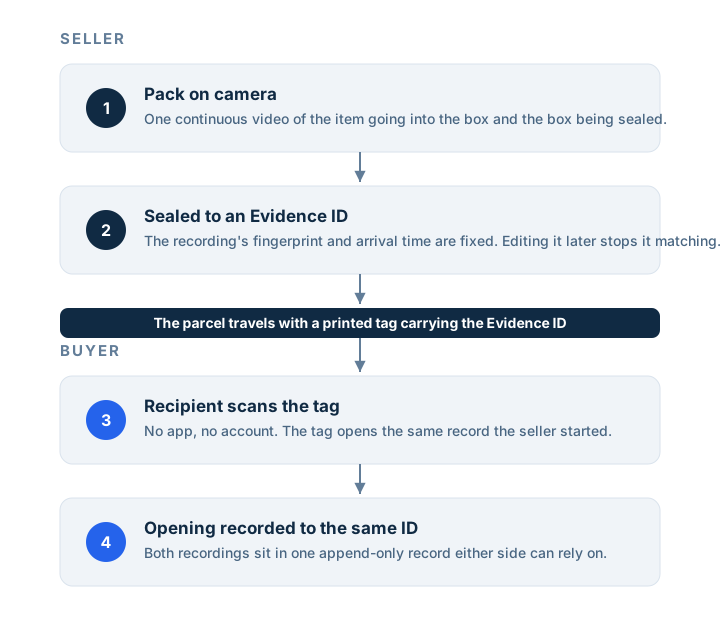
There is a gap in how parcel disputes work that nobody explains until you are in one. Tracking answers whether a parcel arrived. Almost nothing in the system answers what was inside it.
So when a buyer says the box was empty, or held something else, the seller reaches for evidence and finds that most of what they have proves the wrong thing.
The evidence, ranked by what it is worth
- 1
The courier's recorded weight
The strongest thing available, because it is the only figure that comes from neither side. A parcel logged at 840g does not reconcile with an empty mailing bag. Request it in writing, quoting the tracking number, and do it in the first few days: weight and scan data are not kept indefinitely.
- 2
A continuous, unedited packing recording
Strong when it is unbroken and shows the item, the label with the tracking number legible, and the parcel being sealed in one take. A cut is the first thing anyone arguing against you will point at, so a single take is worth more than a tidy edited one.
- 3
Photographs of the item in the packaging
Useful, and much weaker than video, because a photograph shows a moment rather than a sequence. It does not show the item staying in the parcel until it was sealed, which is the exact step in dispute.
- 4
The buyer's photographs of the packaging
Often overlooked and genuinely valuable. Tape that has been opened and re-laid, a slit seam, a bag that arrived with a courier security wrap: those show tampering in transit, which moves the argument away from you entirely. You only ever get these by asking politely and early.
- 5
Proof of postage
Nearly worthless for this question, despite being the thing most sellers name first. It shows a parcel entered the network. It says nothing about contents.
The problem with your own footage
A recording on your own phone has one weakness that has nothing to do with whether you are telling the truth: you control the file. You could in principle have filmed it on another day, filmed a different parcel, or edited it before sending. None of that is an accusation, it is simply what the other side gets to say, and there is no way to answer it from inside the file itself.
What closes that gap is a record made somewhere the person it would benefit cannot alter it afterwards.
The weight record, and how to actually ask for it
Couriers weigh parcels. The receipt printed at a drop-off point usually shows the weight at acceptance, and Evri asks every sender to measure and weigh their parcel before drop-off and warns that overweight or oversized items can lead to an additional charge. That charge can only come from a check made inside the network, after the parcel left you. So a recorded weight can exist even though nobody shows it to you. You have to ask.
- 1
Start with the receipt you already hold
If the drop-off receipt shows a weight, photograph it next to the order page for that sale. That pairing, weight plus order, is worth keeping because the number was printed by the courier's equipment, not typed by you.
- 2
Ask the courier in writing
Quote the tracking number and ask: “Please confirm in writing the weight recorded for this parcel at acceptance and at any later point in your network.” A written answer can be forwarded to a marketplace; something said on a phone call cannot. Do it in the first few days, because weight and scan data are not kept indefinitely.
- 3
If support stalls, ask formally
UK data protection law gives you the right to ask an organisation what personal information it holds about you. It must respond within one month at most, and in most cases cannot charge you for it. Name the tracking number and ask for the data held against your account and that shipment. Not every reading a courier takes is necessarily linked to you, so you may get all of it, some of it, or an explanation of why not. The request itself costs nothing.
Rank evidence by who controls it
Look back at the ranking and notice what it is really sorted by. Not clarity, not effort. Control.
- Evidence held by a neutral party carries the most weight. The courier's figure comes from equipment owned by a company with no stake in your dispute. Neither you nor the buyer can move it.
- Evidence produced by the other side comes next. The buyer's own photographs of tampered packaging are awkward for the buyer to argue against, because the buyer supplied them.
- Evidence you control comes last, however honest it is. A reviewer at a marketplace has never met you. They cannot tell a truthful seller's footage from a dishonest seller's footage by looking at it, so they discount both.
The practical rule that falls out of this: for anything you produce yourself, get a copy out of your own hands as early as possible. Uploading the packing video to the marketplace's own message thread on the day of postage is a crude version of this. From that moment the platform holds a copy with its own timestamp, and the objection that you could have made the recording later gets harder to sustain.
Building a record before you need one
Every seller who has been through this ends up doing some version of the same routine. It is worth adopting before the dispute rather than after.
- Film in one take. Show the item, then the label with the tracking number readable, then the seal. No cuts.
- Seal along the join rather than across a flat face, so the parcel cannot be opened without visible damage.
- Keep the drop-off receipt with the weight printed on it. That is the number you will want.
- Decide a threshold and stick to it. Most sellers land somewhere around £50: below it the effort is not worth the risk, above it it plainly is.
Timestamps and continuity for DIY video
Two objections sink self-made packing footage: that it was filmed on a different day, and that something happened off camera. Each has a cheap defence, and both have to be in place before the parcel is sent.
On time:
- Do not lean on file metadata. The date on a video file is written by your phone and can be rewritten when the file is trimmed, exported or passed through a messaging app. It is an assertion, not a proof.
- Put the date inside the frame instead. The shipping label is the easiest way: it carries the tracking number, and the label did not exist before the order did.
- Keep the original file untouched and send copies. A master that has never been edited is something you can offer; a master trimmed just to shorten it invites the exact question you filmed to avoid.
On continuity:
- The parcel stays in frame from item to seal. Walking out of shot to fetch tape is the gap whoever argues the other side will point at.
- Lay out everything before pressing record: item, box, filler, tape, label. The take should have no reason to pause.
- End late rather than early. A few extra seconds showing the sealed, labelled parcel from every side costs nothing and closes off the suggestion that it was opened again afterwards.
Common questions
Is a video of me packing it enough?
It helps, and it is better than nothing, but it is weaker than most sellers expect. A file on your own phone can be edited, re-dated or filmed on a different day, and whoever is arguing against you will say exactly that. What strengthens it is anything that ties the recording to a time and to that specific parcel, independently of you.
What is the strongest single piece of evidence?
For contents, the courier's recorded weight at drop-off, because it is the only number that comes from neither side of the argument. A parcel accepted at 840g is hard to reconcile with an empty bag. It is not conclusive and it does not always exist, so ask for it early.
Does proof of postage prove what was inside?
No. Proof of postage shows that a parcel of some description entered the network. It says nothing whatsoever about the contents, which is the single most common misunderstanding among sellers.
Will any of this guarantee I win?
No, and be suspicious of anything that says otherwise. Evidence is reviewed by a marketplace, a payment provider, an insurer or a court, and they decide. What good evidence changes is whether there is anything to review at all, which for most sellers is the actual problem.
How do I get the recorded weight from the courier?
Ask in writing, quoting the tracking number, for the weight recorded at acceptance and at any later point in the network. If ordinary support will not engage, UK data protection law gives you the right to ask an organisation what personal information it holds about you: it must respond within one month at most, and in most cases cannot charge you. Ask early, because weight and scan data are not kept indefinitely.
Do the timestamps on my phone video prove when it was filmed?
Not on their own. A video file's date is written by the phone and can change when the file is trimmed, exported or sent through a messaging app. What helps is a copy that leaves your control early, for example uploaded to the marketplace's message thread on the day of postage, because that copy's timestamp then comes from the platform rather than from you.
This guide describes how evidence is generally weighed in parcel disputes. It is not legal advice, and no marketplace, insurer or payment provider is bound by anything here.
Sources
- Retail compensation policy for loss — Royal Mail
- eBay Money Back Guarantee policy — eBay
- If something you ordered hasn't arrived — Citizens Advice
- Respond to a data protection request — GOV.UK
- Parcel size and weight guide — Evri
Links checked 14 August 2026. If one has moved, tell us and we will fix it.